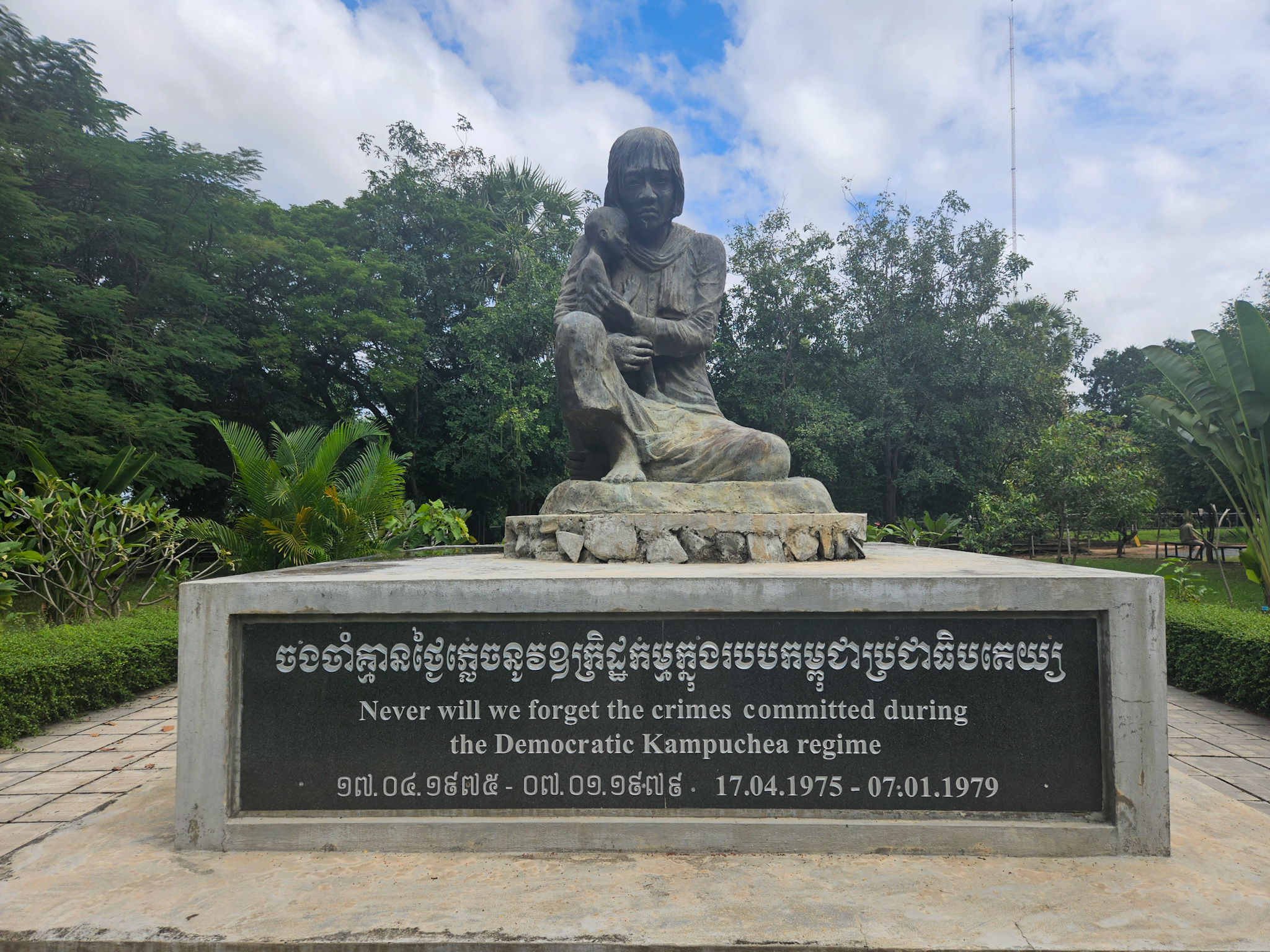
Important Warning: This post contains detail of extremely distressing events which some readers may find difficult to read.
It is unheard of that I find myself, halfway across the globe, consoling a sobbing Australian man I have never met before, in the middle of an ex-prison. There are few places in the world as shocking, as moving, as utterly horrifying as S-21 and the Killing Fields. It will forever stay with me.
Both S-21 and the Killing Fields are central to understanding Cambodia’s modern history. Visiting them is emotionally heavy, but they provide essential context for the resilience of the Cambodian people and the country’s admirable recovery after the Khmer Rouge era (1975–1979). It’s not easy, but anyone visiting this wonderful country needs to understand that it’s part of the living history of the people here.
If you’re visiting Cambodia, and thinking of adding these sites to your itinerary, then please do. After visiting Siem Reap and Angkor, we headed to the capital Phnom Penh, and our day exploring these sites there was heavy and impactful. I hope this post is helpful in preparing you, and shedding a light on a story which must never be forgotten.
Tuol Sleng Genocide Museum (S-21)
Top Tip: Visit S-21 before the Killing Fields, in the same way the prisoners themselves would have done, and to learn the context.
Background
Tuol Sleng was originally a high school (Tuol Svay Prey High School) before being turned into Security Prison 21 (S-21) by the Khmer Rouge regime. It became one of the regime’s main interrogation and torture centers. At least 14,000 people passed through S-21; only 6 survived. Today, it is preserved as a museum and memorial.
Further Information: The Khmer Rouge, a Communist movement led by Pol Pot, ruled Cambodia from 1975 to 1979 and attempted to create a radical, classless agrarian society. They emptied cities, abolished money and institutions, and forced millions into brutal rural labor. During their rule, 1.5–2 million people (25% of the population) died from execution, starvation, disease, or overwork. Their legacy remains one of the deadliest genocides of the 20th century.

Visiting S-21 Today
- You can visit S-21 on a guide led tour, which can bring to life the stories from a local. I saw most of these tours were around half a day (for both sites), and knew that I would want longer.
- We visited independently and bought tickets and the audio guide. The audio guide is essential if visiting independently.
- Entry is $10 per person for entry and the audio guide.
- We spent 2.5hrs at S-21.
- Wear respectful clothing – cover your shoulders and knees.
- Keep your voice low and consider creating space for those around you who may be emotionally affected.
The audio guide starts in the prison cells. Immediately the museum is heavy hitting, with photos on the walls of dead prisoners. The cells are largely left exactly as they were found in 1979, with iron beds and shackles in the floor. The photos show how the person in the cell was found. All of them were dead; tortured and mutilated.
In the second cell block, there is a large gallery of photos of the Khmer Rouge officers, many of them children indoctrinated in to the regime, taught to kill fellow Cambodians. There are also mugshots taken of the prisoners on arrival (adults, teenagers and children). Looking in to the eyes of children is truly heartbreaking.

A number of the prisoners’ personal stories are told via testimonies. A Cambodian schoolteacher, Choeung Ek, was arrested along with his wife and children after being accused—without evidence—of spying. Like many families brought to S-21, they were photographed, interrogated under torture, and ultimately executed. It was the regime’s approach to wipe out entire families so no-one was left to take revenge.
There were hundreds of stories, not just of Cambodians, but foreigners too. Aged 26, New Zealander Kerry Hamill was on a sailing trip with friends when he mistakenly found himself in Cambodian waters. He was arrested and taken to Tuol Sleng prison, where he was tortured and murdered. Kerry’s brother, Rob Hamill, later testified against the infamous torturer Comrade Duch.
There are also multiple exhibits on the Khmer Rouge system, including documents, confessions, torture weapons and more. Particularly impactful items include the gallows from which prisoners were suspended, a room full of human skulls and bones, and photos of mutilations.


Within the prison are a number of spaces dedicated to reflection and remembrance. The entire place feels like it’s full of evil, and the stories which are told so poignantly on the audio guide moved me to tears. I saw at least 20 other people during my visit doing the same.
Important Note: Please consider when, and of what, you take photos. I didn’t feel it at all appropriate to take photos of graphic images or of others crying. Please be mindful and considerate of the atmosphere around you, and share the story of S-21 in a respectful way. Please do not pose and smile for photos here.

Choeung Ek Killing Fields
Background
Located about 30–40 minutes outside Phnom Penh, Choeung Ek is the most well-known of the many execution sites used by the Khmer Rouge. Once the S-21 prison had no more room available to bury bodies, prisoners were instead transported here and killed. The site today is a peaceful memorial park dedicated to honoring them.
Visiting the Killing Fields Today
- If you’re on an organised tour, transport to the Killing Fields will be included from S-21.
- If you’re visiting independently, you can travel by tuk-tuk to the site (download the Grab App to order one).
- Entry is $6 per person including audio guide.
- If visiting independently, the audio guide is essential.
- We spent 2hrs at the Killing Fields.
Arriving at the Killing Fields, the first thing you will see is The Memorial Stupa, filled with the remains of victims. It serves as a central place of remembrance.

The audio guide takes you to walk along a board walk around the mass grave sites. Over 129 mass graves exist here and they are marked with signs explaining what was discovered there. There are grave pits where all the victims were headless, and a pit full of naked women and children.
Important to know: As there were so many people killed here, when the ground shifts in varying weathers, bones still often come to the surface. We saw multiple bones sticking out of the ground. Please do not tread on them; they are collected regularly by the site.
Perhaps the most horrifying part of the board walk is the Killing Tree, now covered in beautiful coloured bracelets in tribute to its victims. It is here that babies were killed by smashing their heads against the tree. I found it hard not to be physically sick listening to the graphic descriptions.


The walking trail audio guide also includes regime survivor accounts. These are really hard to listen to. From guards talking about how they hacked people to death with bits of sharp tree, to severe sexual assault and extreme violence – these are difficult but important listens.
There is also an on-site museum talking more about the Khmer Rouge. I was horrified to learn that far from denouncing the Khmer Rouge regime, they had a seat at the UN!!! They were largely supported by the US and Western Governments (because they were fighting Vietnam and my enemy’s enemy is my friend). Pol Pot himself lived his days out in Thailand. It wasn’t until 20+ years later that the atrocities came to light, and only a small number of individuals were prosecuted for war crimes.
I finished my visit sitting the peaceful gardens surrounding the memorial – a stark contrast between the peace and scenery and the history adds a huge emotional weight.


Emotional Preparation & Self-Care
These sites are deeply moving. The audio guides are some of the best I’ve ever experienced; being respectful to the victims but also being honest about the brutality. They are not easy to listen to. On reflection, I think these tips are helpful to prepare for a visit:
- Go with an open mind and no rush.
- Bring tissues; many visitors cry.
- Take breaks if needed.
- After the visit, give yourself time to decompress. Don’t book any tourist attractions that day if you can avoid it. Afterwards, we spent 3 hours in a cocktail bar decompressing in silence, and then having one of the most deep conversations of our entire marriage around how it had impacted us, and it was much needed.
- Most importantly of all, go with a calm and peaceful energy. Avoid talking loudly or making jokes onsite; locals visit to honor loved ones, and the victims deserve respect.

Seeing S-21 and The Killing Fields helps visitors understand the scale of Cambodia’s tragedy, the resilience of its survivors, how important it is to remember and honour victims and how rapidly Cambodia has rebuilt itself. To fail to understand the history is to fail to understand a huge part of this country and its people.
I came away with a deep respect for the Khmer people and their incredible strength. I hope that as the years pass, the Cambodian economy continues to rebuild, and that more people visit this truly inspiring country.


Leave a Reply