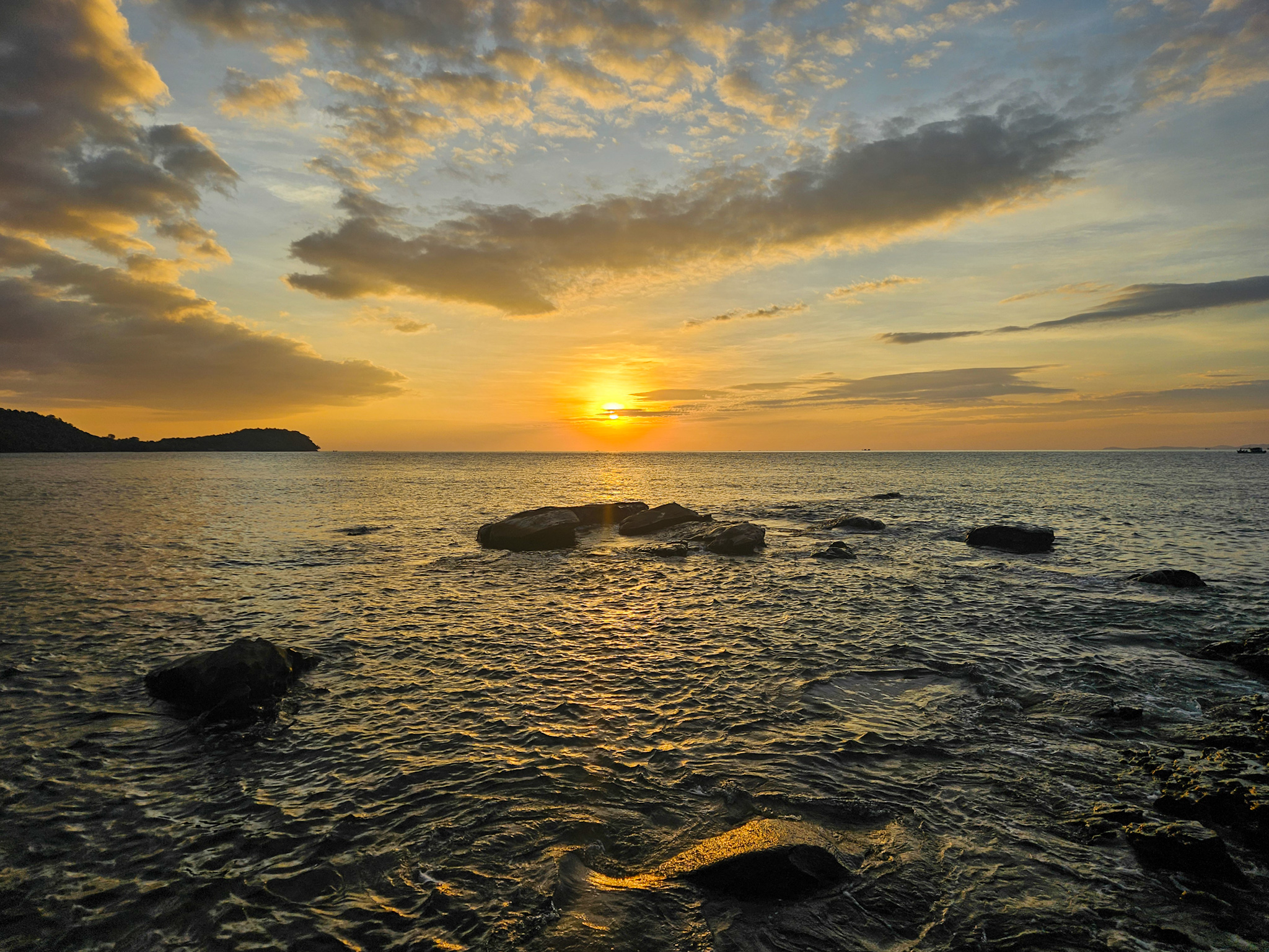
Cambodia is a country of ancient temples, lush countryside, floating villages, vibrant cities, and deeply welcoming people. Without doubt it has been one of the most rewarding countries I’ve ever travelled to, but it also comes with its challenges so I will be completely honest about my experience in this guide.
I wanted to sum up my travel experience in the hope that my hints, tips and experience can be helpful for you if you are planning a trip to this magical country. I can’t recommend going highly enough, and am truly grateful for the time I spent exploring this area of the world.
More Information: You can read all of my posts on Cambodia for more information HERE.
Contents
When to Visit Cambodia
Cambodia has two main seasons:
- Dry Season (Nov – April): This is the best time to visit and is ideal for Angkor temples, Phnom Penh, and the coast. The coolest months within that bracket are Dec-Feb. We visited in November and had consistent 28-30 degree temperatures, a few rain showers, a few days of full sun and mostly cloud. Perfect for exploring.
- Wet Season (May – Oct): There are fewer crowds, but heavy rain is possible which may take away from the ease of sightseeing, plus some rural roads may well turn to mud.
Top Tip: Pick a trip in either November or April to avoid the swell of the crowds, but still benefit from the better weather.


What to see and do in Cambodia
Siem Reap & Angkor Archaeological Park
Read my full guide to Angkor HERE and Siem Reap HERE.
Angkor is the absolute heart of Cambodia’s heritage, and a must see on any visit to this incredible country. Without a doubt a once in a lifetime experience, exploring the many temples of the Angkor site is an absolute must.
Visiting Angkor means you’ll be staying in the town of Siem Reap, which also has experiences to offer beyond the Park. Some of the key temples and sights to explore are:
- Angkor Wat – Go at sunrise for an extra special experience.
- Bayon Temple – The temple of the smiling faces.
- Ta Prohm – One of the most atmospheric places on earth, full of jungle overgrowth and epic roots.
- Tonle Sap – A huge lake, home to a number of floating villages.


Phnom Penh
Cambodia’s lively capital is a delight to explore. It has lots of brilliant sites and is a key place to learn more about Cambodia’s horrific recent past. It’s a city with a really unique, chaotic and vibrant vibe, and we really enjoyed our time there.
- Royal Palace & Silver Pagoda
- National Museum
- Tuol Sleng Genocide Museum (S-21)
- Choeung Ek Killing Fields
Important Note: Genocide sites are emotionally heavy but essential for understanding the country’s history. You can read my full guide to these sites HERE.


Sihanoukville & Islands
Sihanoukville used to be a sleepy little beach town on Cambodia’s coastline. However, it has recently undergone a significant amount of Chinese investment, changing the face of it. I don’t recommend a stay in Sihanoukville itself, but instead use it as the entry point to Cambodia’s beautiful islands. There are lots to choose from, including:
- Koh Rong – Long beaches, nightlife in Koh Toch.
- Koh Rong Sanloem – Quiet, calm, picture-perfect.
- Koh Ta Kiev – Rustic and off-grid.
- Koh Krabey – home to a luxury wellness resort with lots of sea and land activities.
Read my guide to Krabey Island HERE.


Other Towns – Battambang, Kampot & Kep
Slightly more off the beaten track, Battambang is one of Cambodia’s laid back cities, with colonial charm. It offers the famous Bamboo Train, a multitude of beautiful countryside cycling tours, the Bat Caves and the notorious Phnom Sampeau Killing Caves.
Heading right down to the south coast, Kampot and Kep are perfect for slow travel lovers. Here you can visit Kampot Pepper Farms, enjoy the Kep crab market, or visit Bokor National Park.

How to travel around Cambodia?
Travel Overview: Cambodia can be a challenging country to travel around. I would rate overall travel challenge as MODERATE when compared to other countries in South East Asia.
Between Cities
- Infrastructure is moderately developed.
- There is a brand new international airport which is absolutely beautiful, and totally world class. It was also deserted, meaning we were arrival to gate in 8 minutes.
- Some stretches of main road are well developed (e.g. Phnom Penh to Sihanoukville: 3hrs).
- Other stretches are underdeveloped (e.g. Phnom Penh to Siem Reap: 6hrs).
- Infrastructure investment is high at the moment, especially from Chinese investment so I expect this to improve rapidly over the next few years.
- There is only one highway.
- Rural roads are often very underdeveloped and hard to travel.
- Buses (Giant Ibis and Virak Buntham) run between the major cities.
- Domestic Flights are available between Phnom Penh, Siem Reap and Sihanoukville for ease.
- Private Transfers can be arranged via many hotels.
- Rest stops on under developed routes are hit and miss – I would not recommend eating at any of them (we got food poisoning from one).


Within Cities
- Tuk-tuks: Use PassApp or Grab to hire in advance (like Uber), otherwise price negotiations can be tricky.
- Scooter rentals: Please only do this if you are experienced; traffic is hectic.
- Bicycles: in Siem Reap and Battambang.
- Be prepared for un-roadworthy vehicles, hectic and loud traffic and even children driving scooters/mopeds – particularly in Phnom Penh.

Is Cambodia safe?
Summary: Cambodia was generally safe in my experience, however use common sense and precautions when travelling.
Cambodia is categorised as a Least Developed Country by the UN, one of 46 in the world. That means low income, low health & education, and high economic vulnerability are characteristics of the country.
Health & Safety
- Traffic:
- Cambodia has busy, unpredictable, often unroadworthy traffic, especially in Phnom Penh.
- Children drive scooters and are often 3 to a scooter driving to school with no helmets – please be careful.
- Use reputable tuk-tuks via the PassApp or Grab.
- Scams:
- They exist everywhere but inflated tuk-tuk prices when negotiating in cash (avoided if you use the apps), tour add on fees and people just coming up to you and asking outright for money do happen.
- We found less scams when compared to Vietnam.
- Health & Hygiene:
- Tap water isn’t drinkable.
- Hygiene standards in some restaurants and markets are not the same as you would find in Europe so choose wisely and eat hot food.
- Vehicle Maintenance:
- Vehicles (tuk-tuks, cars) are often not well maintained and accidents do happen. There are no seatbelts in tuk-tuks so please check before getting in that it looks OK. We saw tuk-tuks with wheels falling off along a motorway, and turned over.
- Some boats are built out of old motorbikes and cars, and accidents have happened. Be careful when taking them at Tonle Sap and to the islands and make sure there are life jackets on board before boarding.
- Land Mines:
- Still present in a number of rural areas near the Thai border, but not near tourist hot-spots. If you are trekking, strictly stay on marked paths.
- Mosquitoes:
- Cambodia is full of mosquitoes, so make sure you get all your jabs before travel.
- Cambodia does have dengue and zika, among other mosquito borne diseases, which aren’t vaccinated against – so please bear this risk in mind.
Top Tip: Download and set up the Grab App in advance to ensure you can book travel within cities when you arrive, without having to worry about any haggling or scams.


Crime
- Petty Crime:
- Bag and phone snatching do occur in Phnom Penh and some areas of Siem Reap.
- Use cross body bags and don’t wave your phone about in the middle of the street or out of the side of a tuk-tuk and you should be fine.
- Organised Crime:
- It is widely reported that criminal organizations have established a large-scale ecosystem for cybercrime in Cambodia, operating out of compounds that rely heavily on human trafficking and forced labour.
- Workers are lured by fake job advertisements, then trafficked into these compounds.
- Victims are subjected to torture, beatings, and forced to carry out online fraud under threat of violence, starvation, or being sold to other criminal groups.
- Do not accept a job offer in Cambodia unless you are certain of its legitimacy.
- As a tourist, this side of the country was not visible to me.
Note: Thailand and Cambodia have a long history of border conflicts, the most recent of which were in June 2025. Please ensure you check the status prior to travelling.
Other Useful Cambodia Information
Visas
- From the UK, we had to complete a full visa application online before arrival. Two copies of the visa must be printed to give to immigration officers.
- We then also had to complete an arrival card up to 3 days prior to arriving. This was held digitally on our phones.
- Visas can be obtained on arrival, but this takes time and if the airport is busy, can waste hours, so it’s easier to do in advance.
- Tourist visas last for 30 days.
Cultural Etiquette
- Dress modestly when visiting temples.
- Don’t touch someone’s head.
- Remove shoes before entering homes or temple areas.
- Avoid pointing feet at people or Buddha statues.
- Always ask before photographing monks.


Money & Budget
Top Tip: Take USD in all denominations. Everywhere will take it, but it’s hard to withdraw in small denominations once in Cambodia.
- Currency: US dollars widely used alongside Cambodian riel.
- ATMs are available in major cities, however only let you withdraw in 100USD notes. This isn’t very helpful as many small businesses and companies do not take such high denominations.
- Budget meals can be obtained for around $5, and a good meal in a restaurant will cost around $15.
- Tuk-tuks cost around $2–4 short rides.
- The Angkor Pass to explore the Angkor Archaeological site costs $37 USD (1 day), $62 (3 days) or $72 (7 days).
- Hotels come in a full range of costs. Very broadly budget hotels can be around $30/night, mid-range around $80, and luxury around $200. Some of the luxury beach resorts can be up to $800/night.


Cambodia Travel vs. South East Asia
Cambodia is a wonderful country, and part of my favourite area of the world – South East Asia. I thought it would be worth me sharing my thoughts on the comparison between travelling in countries in the area so you can see how Cambodia fits in to that.
We found the locals to be really friendly and encouraging of foreign visitors, with a real will to grow and better their tourist economy. We were continuously asked for feedback on our experience, even in small restaurants.
| Country | Singapore | Malaysia | Thailand | Vietnam | Cambodia | Laos |
|---|---|---|---|---|---|---|
| Travel Ease | 5⭐ | 4 ⭐ | 4 ⭐ | 3 ⭐ | 3 ⭐ | 2 ⭐ |
| Transport | 5 | 5 | 4 | 3 | 3 | 2 |
| English Level | 5 | 5 | 4 | 3 | 2 | 2 |
| Safety | 5 | 4 | 4 | 3 | 3 | 3 |
| Cost | 5 (High) | 4 | 3 | 3 | 2 (Cheap) | 1 |
| Best For | Futuristic City | Food & Culture | A bit of Everything | Food & Adventure | Culture & Temples | Slow eco Travel |
Summary: How Challenging is it to travel around Cambodia?
If you’re used to traveling in:
- Singapore, Thailand or Malaysia: Cambodia will feel a more rugged, hectic and less organized.
- Vietnam: Cambodia will feel similar.
- Laos: Cambodia will feel easier.
- Myanmar: Cambodia will feel much easier and more convenient.
Bottom Line:
👉 Cambodia is beginner/intermediate-friendly as long as you’re comfortable with a bit of Southeast Asian chaos, and it rewards travelers with culture, history, and natural beauty that’s hard to match.


And that’s a wrap on Cambodia, with this post being the last one from my 1 month South East Asia trip. I really hope that you enjoyed the last few months of posts and that if you’re planning to visit Cambodia, this post may help you plan. I found my journey exploring it rewarding, emotional and deeply moving in many ways and I hope its tourism industry can continue to grow and support this resilient, friendly, and welcoming nation.
So for now it’s goodbye to South East Asia….though not for long (if I’m completely honest with you, I’ve only just returned from another trip to the region)! Stay safe and happy travelling!


Leave a Reply