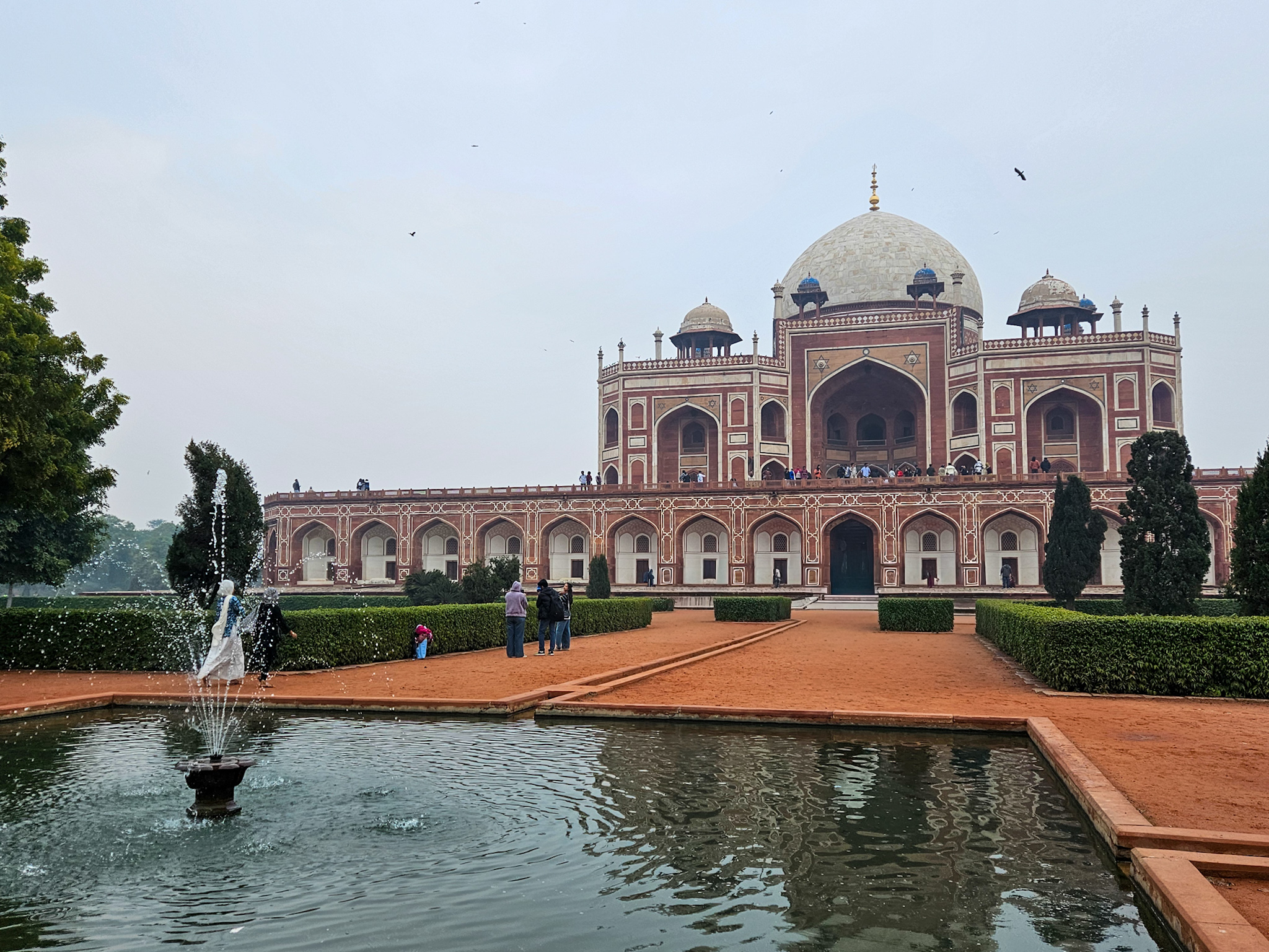
It’s time to take you to India! So far this year I have had two trips to New Delhi – one in January, and one just last week. Both visits have been on work trips, but I decided that instead of just staying in my hotel (lovely as it was), I had to try and at least see a bit of Delhi across the trips.
On my first trip, I only had about 4 hours of daylight time free, immediately after landing, so I decided to see one thing properly rather than try and rush round anything else.
I’ve long been interested in India’s Mughals – inspired by the books of William Dalrymple – and so first on my list was one of their most famous sites; the absolutely incredible Humayun’s Tomb.
Tucked away in the leafy neighborhood of Nizamuddin East, Humayun’s Tomb feels like a quiet world apart from the chaos of Delhi. Stepping through its gates is like entering the early days of the Mughal Empire, where architecture, power, and Persian aesthetics come together to create something timeless. It really is stunning, and long before the Taj Mahal became India’s most famous monument, Humayun’s Tomb set the blueprint.


Contents
The History of Humayun’s Tomb
Humayun’s Tomb was commissioned in 1565 by Empress Bega Begum, the devoted widow of Emperor Humayun, one of the most famous Mughals. Designed by the Persian architect Mirak Mirza Ghiyas, the monument marked a turning point in Indian architecture. It was the first grand garden-tomb on the Indian subcontinent, introducing the Persian charbagh layout; a four-part garden symbolizing paradise.
This design would go on to influence Mughal masterpieces for generations, most famously Shah Jahan’s Taj Mahal nearly a century later.
Humayun himself was the second Mughal emperor, ruling an empire still finding its footing. His reign was marked by exile, loss, and eventual restoration.
The tomb is also where the very last Mughal, Zafar, took shelter after fleeing the Red Fort. The Mughal Empire was effectively ended by Colonialism, as Zafar was captured by Major William Hodson on September 20, 1857. After a trial, the British deported him to Rangoon in 1858, where he lived in poverty and died.


What to see and do at Humayun’s Tomb
The Gardens and the Gateways
Your visit begins with a long walk through meticulously restored gardens, divided by water channels and pathways. These gardens aren’t just decorative, they represent the Mughal vision of heaven on earth, with flowing water, symmetry, and balance.
Before reaching the main tomb, pause at the grand entrance gateways, which frame the monument perfectly. I love the clever framing, and use of perspective – sometimes the main tomb feels close, other times far away, depending on angle and archways.

The Main Tomb
The tomb itself rises from a high platform, constructed primarily of red sandstone with striking white marble detailing. The contrast gives it both warmth and elegance. I actually noticed most of the striking architecture in Delhi is red sandstone, as it’s the most available local material. It adds richness and a colour vibrancy that I found quite unique to India.
Climb the steps and walk around the exterior to admire the massive double dome, one of the earliest of its kind in India, the deep arched recesses on all sides, and the delicate stone latticework (jali) filtering light and air.
The symmetry is mesmerizing, and no matter where you stand, the building feels perfectly balanced, even down to fountains and trees.


Inside the Mausoleum
At the heart of the structure lies Humayun’s cenotaph, positioned directly beneath the central dome. This symbolic tomb marks his resting place, while the actual grave lies in a lower chamber.
Surrounding rooms house the tombs of Mughal wives, sons, and nobles, earning the site the nickname “the dormitory of the Mughals.” The interiors are simple but powerful, with echoing chambers and soft light that create a calm, contemplative atmosphere. They were once all covered in jewels, but the British of course stole all of these.


Other Monuments
One of the joys of Humayun’s Tomb is that it’s part of a larger complex filled with lesser-known gems:
- Isa Khan’s Tomb – Predating Humayun’s Tomb, this octagonal structure blends Afghan and Mughal styles and sits quietly near the entrance. Inside you can see some tombs, and I thought it was quite an enchanting building.
- Bu Halima’s Garden and Tomb – Mysterious and lesser understood, Bu Halima is said to have been one of the nurses of Humayun. We will never know for sure, but what a beautiful place to lay in rest.
- Arab Serai – Built to house Persian craftsmen who worked on the tomb, offering insight into the international collaboration behind the monument.
I really enjoyed wandering these sites as they help tell more of the story of Mughal Delhi.


Humayun’s Tomb Visitor Tips
Best Time to Visit
Humayun’s Tomb is beautiful year-round, but the experience is best:
- October to March, when the weather is cooler
- Early morning for tranquility and photography
- Late afternoon when the golden light brings out the richness of the stone
Practical Tips
- Take a tuk-tuk to and from the site; or book an uber or taxi via your hotel. I ventured out solo in a tuk-tuk and didn’t find it too bad, though finding my driver at the end was slightly chaotic, as dozens of street sellers descended trying to sell me everything from paperweights to live chickens.
- Wear comfortable shoes as the grounds are expansive.
- Bring water, especially in warmer months.
- Consider a guide or audio tour to fully appreciate the history.
- Combine your visit with nearby sites like Nizamuddin Dargah or Sunder Nursery to make a full day trip of it.
I should also note that as a solo white woman, I did experience many people coming up to me asking to take photos and touching my hair as they had never seen red hair before. I smiled and was a celebrity for a few hours, but I did find it difficult. I never felt in danger; it was genuine curiosity, but it was also an invasion of the level of personal space I’m used to.


Humayun’s Tomb isn’t just a burial place, but a formative part of Mughal architecture. It inspired one of the most incredible architectural feats in the world, the Taj Mahal, and it’s easy to see why. Quiet, elegant, and full of history, Humayun’s Tomb is one of Delhi’s most rewarding places to explore and I’m so glad to have seen it with my own eyes.
What did you think? Hopefully it’s whetted your appetite as the starter to the main event, because the Taj is coming next week! Let me know in the comments below.
Stay safe and happy travelling!


Leave a Reply